Level Of Development (LOD)- Building Information Modeling (BIM)
BIM scope is extensive in present and as well as in future. Many countries already turned towards BIM and many governments and private organizations made BIM adoption and implementation mandatory for projects. Many countries like the United States, the United Kingdom, Singapore, China, the Scandinavian countries (Norway, Denmark, Finland, and Sweden, etc.), France, South Korea, etc have adopted BIM technology at public level projects.
Read my previous articles –
The Evolution Of Building Information Modeling (BIM)
What is BIM, Not BIM, BIM software and What are they?
LOD in BIM
So, What do you think about LOD in BIM, here we are particularly talking about LOD in BIM only? Not in GIS, AI Business etc.
LOD stands for Level of Development? Or Level of Detail?
In the BIM world, LOD stands for Level of Development. But in other fields, such as the GIS (Geographic Information System) field, LOD stands for Level of Details.(In BIM also we have but It talks more about non geometric information T & C Apply).
Therefore, a lot of time people mix the two in practice. LOD definition is not the same in BIM & GIS also.
A Model Element means an element in the BIM model, It can be just a very simple component or can be a system or assembly of components in the model.
Here, we are talking about the completeness, which means how complete the model element represents the corresponding real-world object(s).
In BIM practice, LOD often refers to the stages that a BIM model (or elements within the model) is expected through the lifecycle of a construction project.
Here, the keyword is the “stages”. And there are five levels, labeled from LOD 100 to LOD 500.
There are six levels of LOD (100 ,200, 300 ,350 ,400 , 500)
LOD 200: The Model Element is graphically represented within the Model as a generic system, object, or assembly with approximate quantities, size, shape, location, and orientation. Non-graphic information may also be attached to the Model Element. Elements in LOD 200 are usually developed in the Schematic Design stage.
LOD 300: The Model Element is graphically represented within the Model as a specific system, object or assembly in terms of quantity, size, shape, location, and orientation. Non-graphic information may also be attached to the Model Element. Elements in LOD 300 are usually developed in the Detailed Design stage.
LOD 350: The Model Element is graphically represented within the Model as a specific system, object, or assembly in terms of quantity, size, shape, orientation, and interfaces with other building systems. Non-graphic information may also be attached to the Model Element. Elements in LOD 350 are usually developed in the Construction Document stage.
LOD 400: The Model Element is graphically represented within the Model as a specific system, object or assembly in terms of size, shape, location, quantity, and orientation with detailing, fabrication, assembly, and installation information. Non-graphic information may also be attached to the Model Element. Elements in LOD 400 are usually developed in the Fabrication & Assembly stage.
LOD 500: The Model Element is a field verified representation (i.e., as-built) in terms of size, shape, location, quantity, and orientation. Non-graphic information may also be attached to the Model Elements. Elements in LOD 500 are usually developed in the As-Built stage.
Did you get any spark in your mind? Cool. So far we have seen LOD in very general terms, Now let’s see what BIM forum 2019 is telling us.
LOD as per BIM Forum 2019
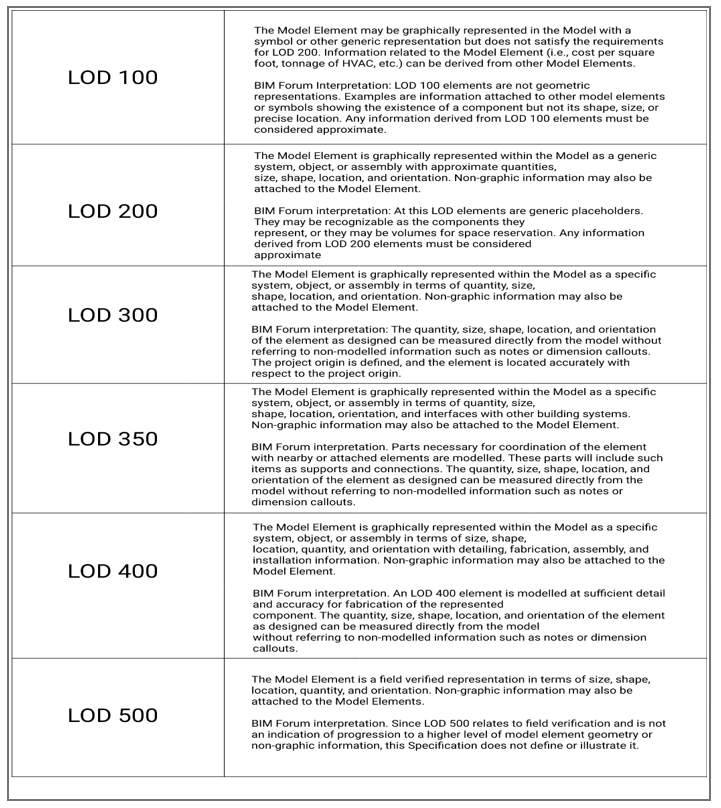
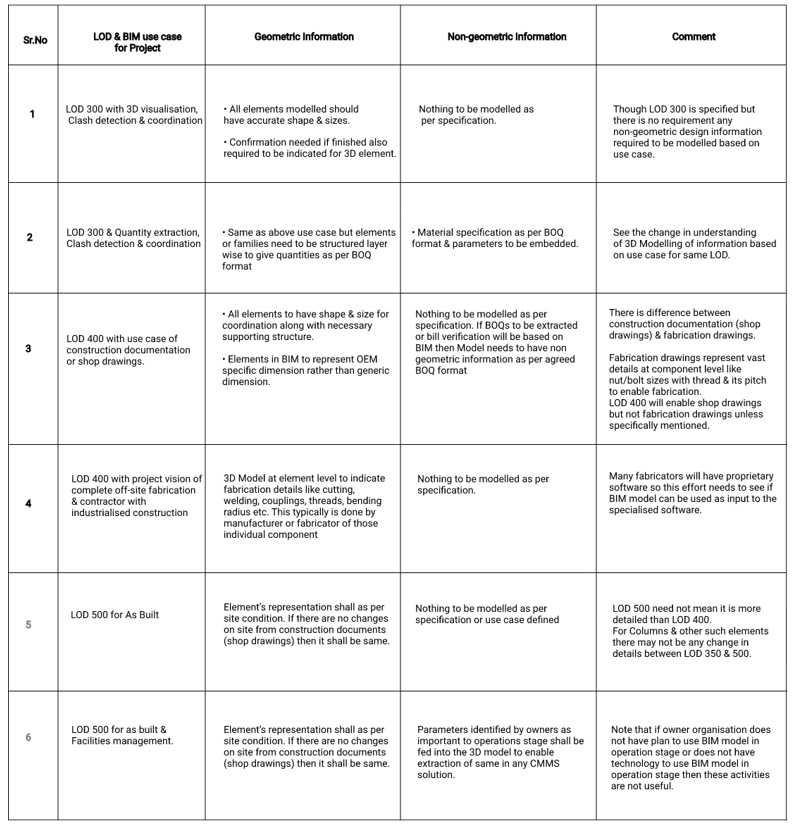
Same time we also should have an understanding about Geometric and non Geometric data.
Thanks & My Presence


Great post! I’m seriously impressed by the quality of your content and website. Also Check,Understanding LOD Conventions in BIM
ReplyDelete